
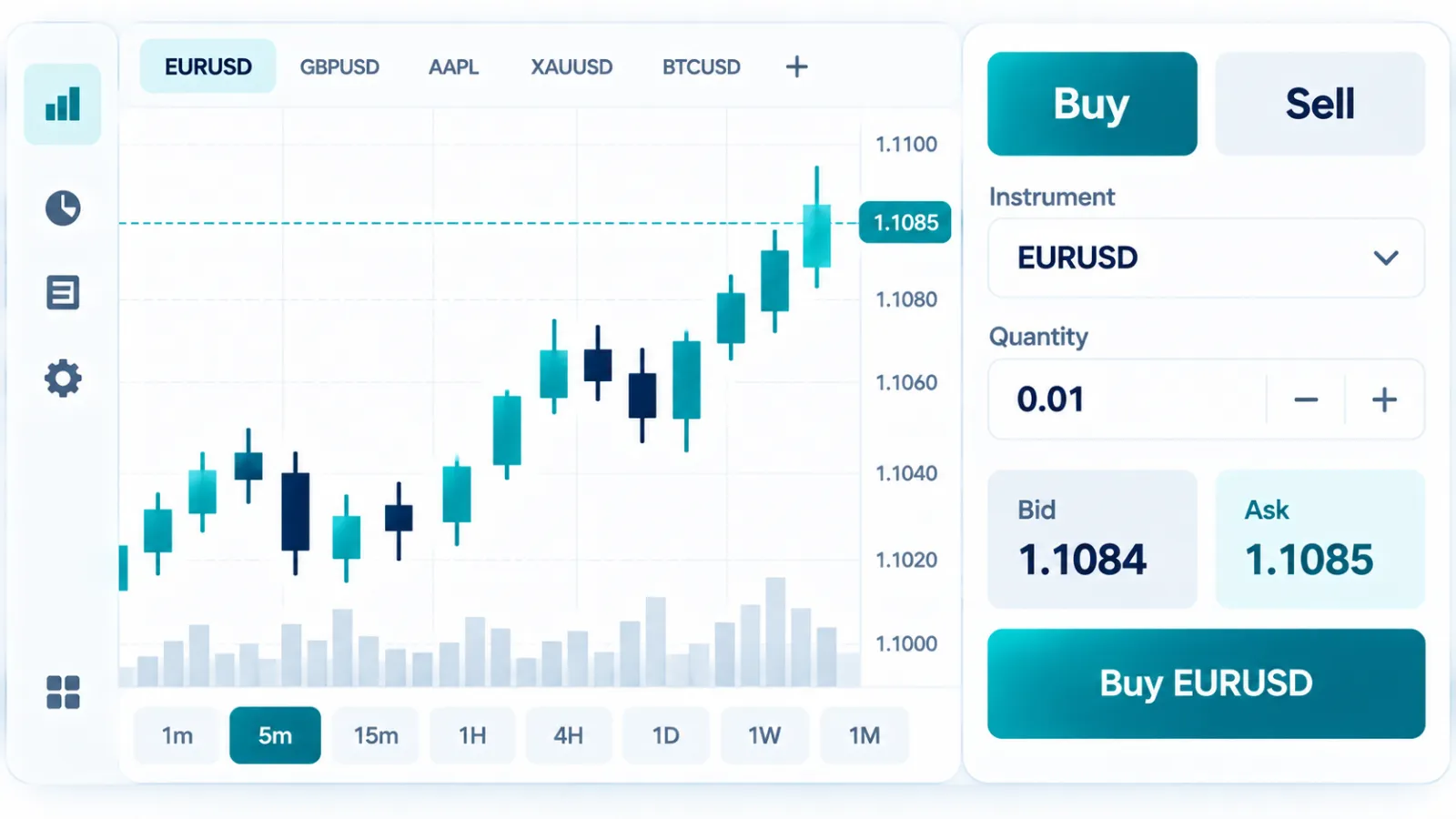
If you have ever heard someone talk about “trading the markets” and wondered what that actually means, you are not alone. Trading is one of the most talked-about topics in finance, yet it is often surrounded by confusing terminology, unrealistic promises, and conflicting information.
This guide introduces trading in plain language. It explains what trading is, how it works at a basic level, what people trade, and why they do it. It also addresses some of the most common misconceptions beginners encounter early in their learning journey.
This article will not teach you how to place a trade or analyze a chart. Those topics are covered in later guides within the Trading Basics category. Instead, this guide focuses on building a clear and accurate foundation so that everything you learn afterward makes sense in context.
By the end of this article, you should understand the core concept of trading well enough to begin exploring how markets and trades actually work.
Written by TradeConverge
.
Updated
.
read
KEY TAKEAWAYS
- Trading is the buying and selling of financial instruments with the goal of profiting from price movement.
- Trading generally involves shorter time horizons than long-term investing, though the two overlap in practice.
- Traders can participate in several markets, including stocks, forex, commodities, cryptocurrencies, and more.
- Trading is accessible to beginners, but it requires education, discipline, and realistic expectations.
- Trading is not a guaranteed path to profit, and losses are a normal part of the process.
- This guide is the starting point for the Trading Basics category, which builds toward more advanced concepts step by step.
What Is Trading?
Trading is the practice of buying and selling financial instruments with the goal of profiting from changes in their price.
A financial instrument is simply something with tradable value, such as a share of a company, a currency pair, or a unit of a commodity like gold. When a trader buys a financial instrument, they are hoping its price will move in a favorable direction so they can sell it for more than they paid, or benefit from the price difference in another way.
Trading takes place through markets, which are structured environments where buyers and sellers exchange these instruments. Some markets, such as stock exchanges, operate through centralized systems. Others, such as the foreign exchange (forex) market, operate through a decentralized network of participants.
At its core, trading is a decision-making process. A trader evaluates available information, forms an expectation about how a price might move, and decides whether to enter or avoid a trade. Because future price movements are never certain, every trading decision involves some degree of risk.
How Does Trading Work?
While the details of executing a trade are covered in a dedicated guide later in this category, it helps to understand the basic process at a high level.
A trader typically works through a broker or trading platform, which provides access to a market. To open a trade, the trader selects a financial instrument and decides whether they expect its price to rise or fall.
If a trader expects the price to rise, they may buy the instrument first and plan to sell it later at a higher price. If a trader expects the price to fall, some markets also allow them to profit from a declining price, although this approach carries its own considerations that go beyond the scope of this introduction.
Price movement itself is driven largely by supply and demand. When more participants want to buy an instrument than sell it, its price tends to rise. When more participants want to sell than buy, its price tends to fall. Many other factors influence supply and demand, including economic data, company performance, and overall market sentiment.
Traders generally do not guess randomly. Most rely on some form of analysis to inform their decisions. Broadly speaking, this involves either studying price charts and patterns or evaluating the underlying value of an asset. Both approaches are explored in detail in later guides within this category.
What Can You Trade?
Financial markets offer a wide range of instruments to trade. Understanding the major categories provides useful context before exploring how each market works individually in future guides.
Common markets include:
- Stocks: Shares representing partial ownership in a publicly traded company.
- Forex: The exchange of one currency for another, such as trading the US dollar against the euro.
- Commodities: Physical goods such as gold, oil, or agricultural products.
- Indices: Groups of stocks bundled together to represent a broader segment of the market, such as a country’s largest companies.
- Cryptocurrencies: Digital assets that operate on decentralized technology.
- Futures: Contracts to buy or sell an asset at a predetermined price on a future date.
- Exchange-Traded Funds (ETFs): Funds that hold a collection of assets and trade on an exchange like a stock.
Each market has its own characteristics, trading hours, and risk considerations. A dedicated guide later in this category explores these markets in greater depth.
Trading vs. Investing
Beginners often use the words “trading” and “investing” interchangeably, but they describe different approaches to participating in financial markets.
| Trading | Investing |
|---|---|
| Typically shorter time horizons | Typically longer time horizons |
| Focuses on price movement | Focuses on long-term growth and value |
| Often involves more frequent decisions | Often involves fewer, longer-term decisions |
| Requires active market monitoring | Often requires less frequent monitoring |
Neither approach is inherently superior. They serve different goals, require different skill sets, and suit different personalities and time commitments. Some people focus exclusively on one approach, while others combine elements of both.
Why Do People Trade?
People trade for a variety of reasons, and understanding these motivations can help you evaluate whether trading aligns with your own goals.
Common reasons people trade include:
- Potential income. Some traders aim to generate additional income alongside other work.
- Flexibility. Trading can often be done independently and on a schedule the trader controls.
- Intellectual interest. Many people are drawn to the analytical and problem-solving nature of studying markets.
- Career development. Some traders pursue trading as a professional path, whether independently or within a financial institution.
- Portfolio diversification. Some investors use trading strategies to complement a longer-term investment approach.
While these motivations are common, trading also involves genuine risk. No motivation changes the fact that losses are a normal and expected part of participating in financial markets.
Common Misconceptions About Trading
Because trading is frequently portrayed in exaggerated or misleading ways online, beginners often start with inaccurate expectations. Addressing these misconceptions early helps build a more realistic foundation.
Misconception: Trading is an easy way to make quick money. In reality, trading requires ongoing learning, practice, and discipline. Consistent results, when they occur, typically develop gradually rather than immediately.
Misconception: Trading guarantees profit. No approach to trading can guarantee a specific outcome. Markets are influenced by probability and uncertainty, not certainty.
Misconception: Trading is the same as gambling. While both involve uncertainty, trading is based on analysis, risk management, and evaluating available information, rather than chance alone.
Misconception: You need to predict the market perfectly. Successful trading is generally less about being right every time and more about managing risk and probabilities effectively over many decisions.
Misconception: You need a large amount of money to begin. While capital requirements vary by market and platform, many beginners start with modest amounts while they focus on learning.
Recognizing these misconceptions early can help you approach trading with more realistic and productive expectations.
Can Anyone Learn Trading?
Trading is a skill, and like most skills, it can be learned with time, effort, and the right educational foundation.
That said, learning to trade is a gradual process. It involves understanding how markets work, developing analytical skills, practicing risk management, and building discipline around decision-making. These are areas that develop through consistent study and practice rather than overnight.
It is also important to set realistic expectations. Not every beginner will experience the same results, and progress often depends on factors such as time invested, consistency, and willingness to keep learning after early setbacks.
Your Next Steps
Now that you understand the basic concept of trading, the next step is learning how financial markets themselves function.
The Trading Basics category is designed to build your knowledge gradually. After this introduction, consider continuing with:
- How Financial Markets Work: Learn how markets are structured and how prices are determined.
- Types of Financial Markets: Explore the major markets introduced in this article in greater depth.
- How Trades Work: Understand what actually happens when a trade is placed.
There is no need to rush. Building a solid foundation now will make every concept that follows easier to understand.
Frequently Asked Questions
Is trading easy? No. While the basic concept is simple to understand, trading effectively requires ongoing education, practice, and discipline. Beginners should expect a learning curve.
Can trading make you rich? Trading can potentially generate profit, but there are no guarantees. Outcomes vary widely, and losses are a normal part of the process. Beginners should avoid unrealistic expectations about quick or guaranteed wealth.
Do you need a lot of money to start trading? Requirements vary depending on the market and platform. Many beginners start with modest amounts while focusing on education rather than large trades.
Is trading the same as gambling? No. Trading relies on analysis, probability, and risk management, whereas gambling typically relies on chance. However, trading without proper education or risk management can carry similarly high levels of unnecessary risk.
How should a complete beginner start learning about trading? A good starting point is understanding how markets work, followed by learning the basics of how trades are placed and how prices move. Continuing through the Trading Basics category in order provides a structured path to build this foundation.
What is the difference between a trader and an investor? A trader typically focuses on shorter-term price movement, while an investor typically focuses on long-term growth. Some people combine both approaches depending on their goals.
The Bottom Line
Trading is the practice of buying and selling financial instruments with the goal of profiting from price movement. It takes place across a variety of markets, appeals to people for different reasons, and is often misunderstood due to unrealistic portrayals online.
While trading is accessible to beginners, it is not a shortcut to easy profit. It requires education, realistic expectations, and a willingness to build knowledge gradually over time.
This guide has introduced the foundational concept of trading. The next step is understanding how financial markets themselves operate, which will build directly on what you have learned here.